
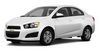
Chevrolet Sonic: Tire Pressure
Chevrolet Sonic Owners Manual
Tires need the correct amount of air pressure to operate effectively.
Caution
Neither tire underinflation nor overinflation is good. Underinflated tires, or tires that do not have enough air, can result in:
- . Tire overloading and overheating which could lead to a blowout.
- . Premature or irregular wear.
- . Poor handling.
- . Reduced fuel economy.
Overinflated tires, or tires that have too much air, can result in:
- . Unusual wear.
- . Poor handling.
- . Rough ride.
- . Needless damage from road hazards.
The Tire and Loading Information label on the vehicle indicates the original equipment tires and the correct cold tire inflation pressures. The recommended pressure is the minimum air pressure needed to support the vehicle's maximum load carrying capacity. See Vehicle Load Limits.
How the vehicle is loaded affects vehicle handling and ride comfort. Never load the vehicle with more weight than it was designed to carry.
When to Check
Check the tires once a month or more. Do not forget the compact spare, if the vehicle has one. The cold compact spare tire pressure should be at 420 kPa (60 psi). See Compact Spare Tire.
How to Check
Use a good quality pocket-type gauge to check tire pressure. Proper tire inflation cannot be determined by looking at the tire. Check the tire inflation pressure when the tires are cold, meaning the vehicle has not been driven for at least three hours or no more than 1.6 km (1 mi).
Remove the valve cap from the tire valve stem. Press the tire gauge firmly onto the valve to get a pressure measurement. If the cold tire inflation pressure matches the recommended pressure on the Tire and Loading Information label, no further adjustment is necessary. If the inflation pressure is low, add air until the recommended pressure is reached. If the inflation pressure is high, press on the metal stem in the center of the tire valve to release air.
Recheck the tire pressure with the tire gauge.
Return the valve caps on the valve stems to prevent leaks and keep out dirt and moisture.


Other info:
Mazda 2. Fuel and Engine Exhaust Precautions
Fuel Requirements (SKYACTIV-G 1.3, SKYACTIV-G 1.5)
Vehicles with catalytic converters or oxygen sensors must use ONLY UNLEADED
FUEL,
which will reduce exhaust emissions and keep spark plug fouling ...
Chevrolet Sonic. Removing the Flat Tire and Installing the Spare Tire
1. Do a safety check before proceeding. See If a Tire Goes Flat.
2. Remove the wheel cover, if the vehicle has one, to reach the wheel bolts.
3. Turn the wheel nuts counterclockwise to loosen th ...
Renault Clio. Front headrests
To raise the headrest
Pull the headrest upwards to the desired
height. Check that it is correctly
locked.
To lower the headrest
Press button 1 and guide the headrest
down to the desired heig ...
Manuals For Car Models
-
 Chevrolet Sonic
 -
 Citroen C3
 -
 Fiat Punto
 -
 Honda Fit
 -
 Mazda 2
 -
 Nissan Micra
 -
 Peugeot 208
 -
 Renault Clio
 -
 Seat Ibiza
 -
 Skoda Fabia
 - Honda Pilot
- Volkswagen ID4
- Toyota Prius
