

Mazda 2: Engine Coolant
Mazda2 Owners Manual
Inspecting Coolant Level
WARNING
Do not use a match or live fl ame in the engine compartment. DO NOT ADD COOLANT WHEN THE ENGINE IS HOT: A hot engine is dangerous. If the engine has been running, parts of the engine compartment can become very hot. You could be burned. Carefully inspect the engine coolant in the coolant reservoir, but do not open it.
 Switch the ignition to
off and
make sure the fan is not running
before attempting to work near the
cooling fan:
Working near the cooling fan when it
is running is dangerous. The fan could
continue running indefi nitely even if
the engine has stopped and the engine
compartment temperature is high. You
could be hit by the fan and seriously
injured.
 Do not remove either
cooling system cap when the engine
and radiator are hot:
When the engine and radiator are hot,
scalding coolant and steam may shoot
out under pressure and cause serious
injury.
NOTE
Changing the coolant should be done by an expert repairer, we recommend an Authorised Mazda Repairer.
Inspect the antifreeze protection and coolant level in the coolant reservoir at least once a year—at the beginning of the winter season—and before travelling where temperatures may drop below freezing.
Inspect the condition and connections of all cooling system and heater hoses.
Replace any that are swollen or deteriorated.
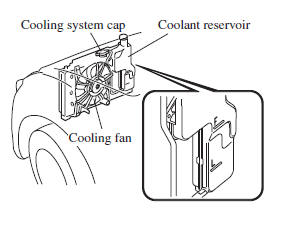
The coolant should be at full in the radiator and between the F or FULL and L marks on the coolant reservoir when the engine is cool.
SKYACTIV-G 1.3 and SKYACTIV-G 1.5
SKYACTIV-D 1.5
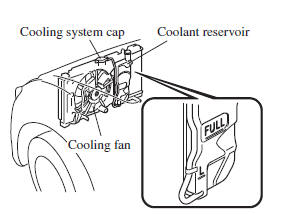
If it is at or near L, add enough coolant to the coolant reservoir to provide freezing and corrosion protection and to bring the level to F or FULL.
Securely tighten the coolant reservoir tank cap after adding coolant.
CAUTION
- Radiator coolant will damage paint.
Rinse it off quickly if spilled.
- Use only soft (demineralised) water in the coolant mixture. Water that contains minerals will cut down on the coolant's effectiveness
- Do not add only water. Always add a proper coolant mixture.
- The engine has aluminium parts and must be protected by an ethyleneglycol- based coolant to prevent corrosion and freezing.
- DO NOT USE coolants Containing
Alcohol, methanol, Borate or
Silicate.
These coolants could damage the cooling system.
- DO NOT MIX alcohol or methanol with the coolant. This could damage the cooling system.
- Do not use a solution that contains
more than 60% antifreeze.
This would reduce effectiveness.
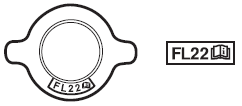
- If the “FL22” mark is shown on or
near the cooling system cap, use
of FL-22 is recommended when
replacing engine coolant. Using
engine coolant other than FL-22 may
cause serious damage to the engine
and cooling system.
If the coolant reservoir is empty or new coolant is required frequently, consult an expert repairer, we recommend an Authorised Mazda Repairer.


Other info:
Nissan Micra. Bluetooth® Hands-Free Phone System
(if so equipped)
WARNING
Use a phone after stopping your vehicle
in a safe location. If you have to use a
phone while driving, exercise extreme
caution at all times so full attention may
be ...
Honda Fit. Daytime Running Lights
The high beam headlights come on slightly dimmer than normal when the
following
conditions have been met:
• The ignition switch is in ON .
• The headlight switch is off, or in .
• The park ...
Mazda 2. Power Steering
Power steering is only operable when
the engine is running. If the engine is
off or if the power steering system is
inoperable, you can still steer, but it
requires more physical effort.
& ...
Manuals For Car Models
-
 Chevrolet Sonic
 -
 Citroen C3
 -
 Fiat Punto
 -
 Honda Fit
 -
 Mazda 2
 -
 Nissan Micra
 -
 Peugeot 208
 -
 Renault Clio
 -
 Seat Ibiza
 -
 Skoda Fabia
 - Honda Pilot
- Volkswagen ID4
- Toyota Prius
