

Honda Fit: Fuel Economy
Honda Fit Owners Manual
Improving Fuel Economy
Fuel economy depends on several conditions, including driving conditions, your driving habits, the condition of your vehicle, and loading. Depending on these and other conditions, you may or may not achieve the rated fuel economy of this vehicle.
Direct calculation is the recommended method to determine actual fuel consumed while driving.
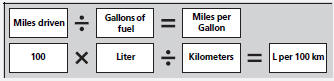
In Canada, posted fuel economy numbers are established following a simulated test. For more information on how this test is performed, please visit http://oee.nrcan.gc.ca/
■Maintenance and Fuel Economy
You can optimize your fuel economy with proper maintenance of your vehicle.
Always maintain your vehicle in accordance with the messages displayed on the information display.
• Use the recommended viscosity engine oil, displaying the API Certification Seal.
• Maintain the specified tire pressure.
• Do not load the vehicle with excess cargo.
• Keep your vehicle clean. A buildup of snow or mud on your vehicle’s underside adds weight and increases wind resistance


Other info:
Honda Fit. VSA® (Vehicle Stability Assist), aka ESC (Electronic Stability Control),
System
VSA® helps to stabilize the vehicle during cornering if the vehicle turns
more or less
than what was intended. It also assists in maintaining traction on slippery
surfaces.
It does so by regu ...
Chevrolet Sonic. Why Safety Belts Work
When riding in a vehicle, you travel as fast as the vehicle does. If the vehicle
stops suddenly, you keep going until something stops you. It could be the windshield,
the instrument panel, or th ...
Renault Clio. Rear screen wash/wipe
Speed-dependent
timed rear screen
wiper
With the ignition on, turn the end of
stalk 1 to align mark 2 with the symbol.
Wiping frequency varies with speed.
When working in the engin ...
Manuals For Car Models
-
 Chevrolet Sonic
 -
 Citroen C3
 -
 Fiat Punto
 -
 Honda Fit
 -
 Mazda 2
 -
 Nissan Micra
 -
 Peugeot 208
 -
 Renault Clio
 -
 Seat Ibiza
 -
 Skoda Fabia
 - Honda Pilot
- Volkswagen ID4
- Toyota Prius
