
Peugeot 208: Additional adjustments
Peugeot 208 Owners Manual
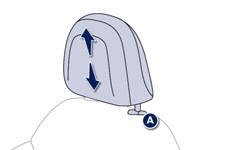
Head restraint height adjustment
To raise the head restraint, pull it upwards.
To remove the head restraint, press the lug A and pull the head restraint upwards.
To put the head restraint back in place, engage the head restraint stems in the openings keeping them in line with the seat back.
To lower the head restraint, press the lug A and the head restraint at the same time.
The head restraint is fitted with a frame with notches which prevents it from lowering; this is a safety device in case of impact.
The adjustment is correct when the upper edge of the head restraint is level with the top of the head. Never drive with the head restraints removed; they must be in place and adjusted correctly.
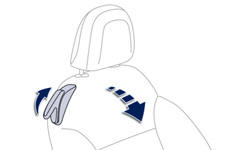
Access to the rear seats (3-door)
Pull only this control upwards to fold the seat back and move the seat forward.
When put back in place, the seat returns to its initial position.
Ensure that no person or object prevents the seat slide from returning to its initial position; the return to this position is necessary for longitudinal locking.
Check that the seat belt has reeled in correctly so as to not impede access for passengers to the rear seats.


Other info:
Chevrolet Sonic. Climate Control Systems
These climate control systems control the heating, cooling, and ventilation for
the vehicle.
Climate Control System with Heater and Air Conditioning
1. Temperature Control
2. Fan Control
3. Ai ...
Chevrolet Sonic. Fuses and Circuit Breakers
The wiring circuits in the vehicle are protected from short circuits by a combination
of fuses, circuit breakers, and fusible thermal links. This greatly reduces the
chance of fires caused by elec ...
Peugeot 208. Manual controls
The wipers are controlled directly by the driver.
Model without AUTO wiping
Model with AUTO wiping
Windscreen wipers
Wiping speed:
Rear wiper
Rear wiper selection ring:
park,
intermi ...
Manuals For Car Models
-
 Chevrolet Sonic
 -
 Citroen C3
 -
 Fiat Punto
 -
 Honda Fit
 -
 Mazda 2
 -
 Nissan Micra
 -
 Peugeot 208
 -
 Renault Clio
 -
 Seat Ibiza
 -
 Skoda Fabia
 - Honda Pilot
- Volkswagen ID4
- Toyota Prius
