

Honda Fit: VSA® (Vehicle Stability Assist), aka ESC (Electronic Stability Control), System
Honda Fit Owners Manual
VSA® helps to stabilize the vehicle during cornering if the vehicle turns more or less than what was intended. It also assists in maintaining traction on slippery surfaces.
It does so by regulating engine output and selectively applying the brakes.
The VSA® may not function properly if tire type and size are mixed. Make sure to use the same size and type of tire, and the air pressures as specified.
When the VSA® indicator comes on and stays on while driving, there may be a problem with the system. While this may not interfere with normal driving, have your vehicle checked by a dealer immediately.
VSA® cannot enhance stability in all driving situations and does not control the entire braking system. You still need to drive and corner at speeds appropriate for the conditions and always leave a sufficient margin of safety.
The main function of the VSA® system is generally known as Electronic Stability Control (ESC). The system also includes a traction control function.
VSA® Operation
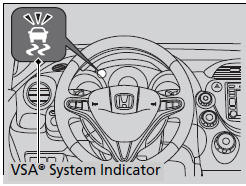
When VSA® activates, you may notice that the engine does not respond to the accelerator.
You may also notice some noise from the hydraulic system. You will also see the indicator blink.
VSA® On and Off
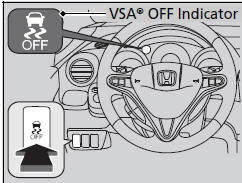
This button is on the driver side control panel.
To turn the VSA® system on and off, press and hold it until you hear a beep.
VSA® will stop and the indicator will come on.
To turn it on again, press the  (VSA®
(VSA®
OFF)
button until you hear a beep.
VSA® is turned on every time you start the engine, even if you turned it off the last time you drove the vehicle.
Without VSA®, your vehicle will have normal braking and cornering ability, but it will not have VSA® traction and stability enhancement.
In certain unusual conditions when your vehicle gets stuck in shallow mud or fresh snow, it may be easier to free it with the VSA® temporarily switched off.
When the VSA® system is off, the traction control system is also off. You should only attempt to free your vehicle with the VSA® off if you are not able to free it when the VSA® is on.
Immediately after freeing your vehicle, be sure to switch VSA® on again. We do not recommend driving your vehicle with the VSA® and traction control systems switched off.
If the low tire pressure* or TPMS indicator* comes on
or blinks, the VSA® system comes on automatically. In
this case, you cannot turn the system off by pressing
the button.
You may hear a motor sound coming from the engine compartment while system checks are being performed immediately after starting the engine or while driving. This is normal.


Other info:
Nissan Micra. Adjusting the screen
The procedure for adjusting the display settings
of the screen differs depending on the type of
screen present on the vehicle.
Firmly apply the brake and place the shift
lever in R (revers ...
Renault Clio. Display A
To access display 1 for setting the time,
press button 2 or 3. Wait for a few seconds.
The hours and minutes flash and you
are now in setting mode; press and
hold button 2 or 3 to set the ho ...
Ford Fiesta. Parking Aids
Principle of Operation
WARNINGS
The system does not relieve you of
your responsibility to drive with due
care and attention.
If your vehicles has a non-Ford
approved trailer tow module the
system may ...
Manuals For Car Models
-
 Chevrolet Sonic
 -
 Citroen C3
 -
 Fiat Punto
 -
 Honda Fit
 -
 Mazda 2
 -
 Nissan Micra
 -
 Peugeot 208
 -
 Renault Clio
 -
 Seat Ibiza
 -
 Skoda Fabia
 - Honda Pilot
- Volkswagen ID4
- Toyota Prius
